The Nuanced Guide to Energy Balance: What “Calories In, Calories Out” Really Means
If you have ever heard someone explain weight, metabolism or nutrition with the phrase “calories in versus calories out”, you may have been left with the impression that your body works like a calculator: eat this many calories, burn that many calories, and get the expected result - except human bodies are not spreadsheets.
Energy balance is real science, but how it is often talked about can strip away much of the context that makes it useful. Your body constantly uses energy to keep you alive, move you through the world, digest food, and adapt to what is happening around you. How much energy you use can also vary with factors such as body size, body composition, age, and physical activity.
At Nutriten, we think understanding energy balance can be useful without turning your meals into a maths exercise. This guide aims to help you understand what energy balance means, what contributes to the energy your body uses, and how to apply that knowledge without becoming obsessed with numbers.

Quick answer
Energy balance describes the relationship between the energy you consume through food and drink and the energy your body uses. Over time, consistently consuming more energy than your body uses can contribute to weight gain, while consistently consuming less can contribute to weight loss. Whilst that principle is real, the human side of the equation is much more dynamic than the phrase “calories in, calories out” makes it sound. Your body uses energy at rest, through movement and exercise, and while digesting food, and those amounts can vary considerably from person to person. Understanding this is less about calculating every calorie and more about appreciating how your body uses the fuel you give it.
First, what is a calorie?
A calorie is a unit of energy. The word has picked up a lot of emotional baggage over the years; people often talk about calories as though they are something we need to avoid, earn, or burn off after eating, when in reality, your body needs energy constantly. You need it for your heart to beat, your brain to function, your lungs to work, your muscles to move, and your body to maintain all the processes happening behind the scenes while you go about your day - food provides that energy.
Before we go any further, it is worth separating the science from the judgement: calories are a measurement, not a measure of whether a food is good or bad. That distinction matters, because once we stop attaching morality to the number, we can start understanding what it’s actually telling us.
Where does your daily energy actually go?
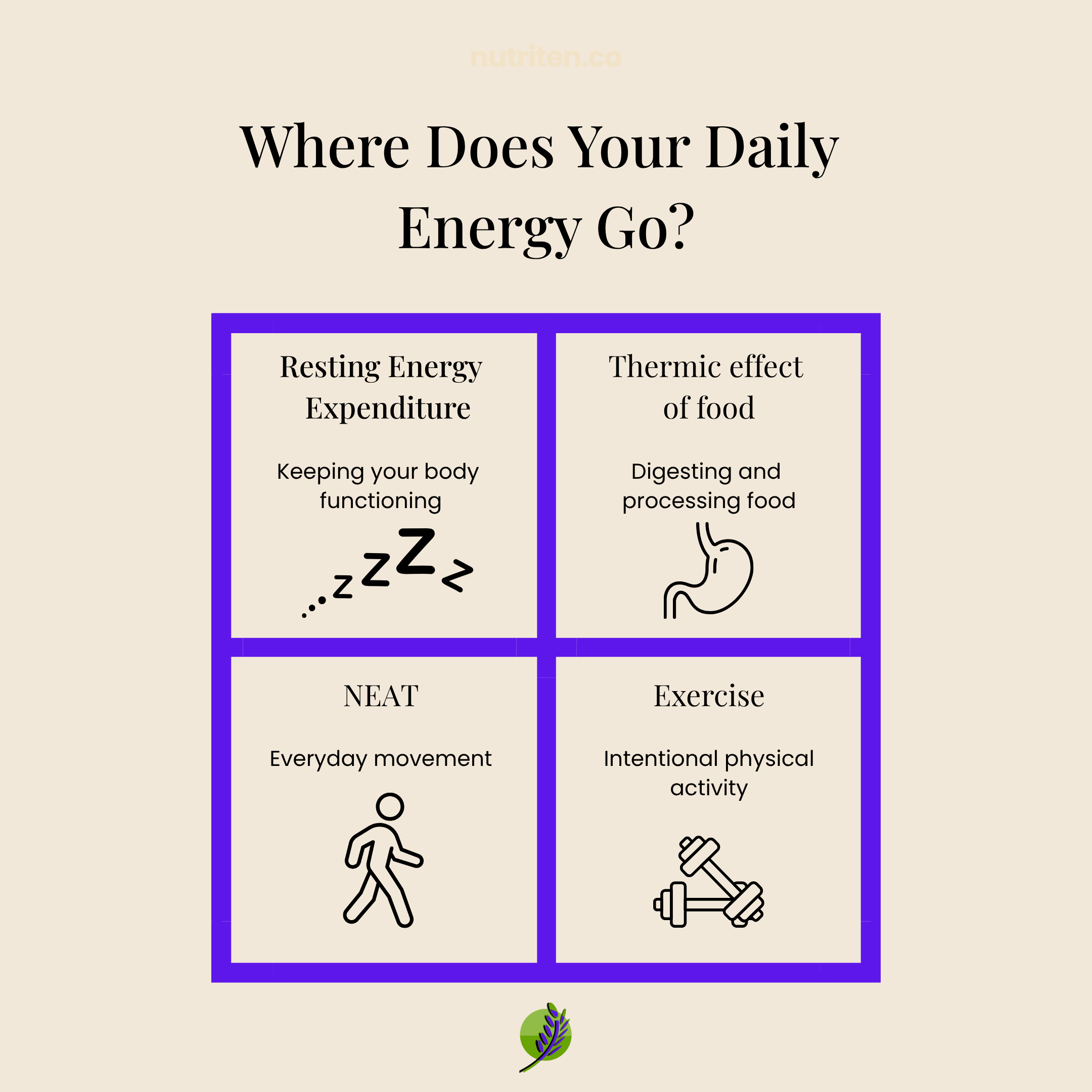
Your total daily energy expenditure (TDEE) is the energy your body uses throughout the day. Rather than thinking of it as a single “calorie burn” number, it helps to understand the different things that contribute to it.
Resting energy expenditure
For most people, the largest share of energy goes towards keeping the body functioning. Even if you spent the entire day resting, your body would still need energy to maintain your organs, circulation, breathing, nervous system and other essential processes. You may see this referred to as basal metabolic rate (BMR) or resting metabolic rate (RMR). They are measured slightly differently, but both describe the energy required to support basic bodily function at rest. This is an important reminder that your body isn't only “burning calories” when you exercise; it is also working all day, every day.
The thermic effect of food
Your body also requires energy to process the food you eat. The thermic effect of food (TEF) describes the energy your body uses to digest, absorb and process nutrients after eating. Different macronutrients require different amounts of energy to process. Protein generally has a higher thermic effect than carbohydrate and fat, for example.
That doesn't mean you need to choose foods based on how many calories they supposedly “burn” during digestion. It is simply another example of why energy expenditure is more complicated than your workout tracker might suggest.
Everyday movement
Then there is everything you do that involves movement without necessarily thinking of it as exercise. Walking to the bus stop, standing while cooking, cleaning the house, carrying your shopping, taking the stairs, moving around at work, or even pacing while you are on the phone all require energy. Researchers often describe this as non-exercise activity thermogenesis, commonly shortened to NEAT.
NEAT can vary considerably between people because our jobs, environments, routines and lifestyles can look completely different. Someone working on their feet all day may naturally accumulate much more movement than someone working at a laptop for eight hours, even if they both complete the same 45-minute gym session afterwards.
Intentional exercise
Finally, there is deliberate exercise: walking for fitness, running, cycling, swimming, strength training, sports, dancing, yoga or whatever type of movement works for you. How much exercise contributes to someone's total daily energy expenditure depends on the type, frequency, duration and intensity of the activity. For somebody training regularly, it may contribute considerably more than it does for someone who exercises occasionally. The useful point is not that exercise “doesn't matter”; it is that exercise is only one part of the way your body uses energy.
Why can two people have very different energy needs?
This is where the simple calculator analogy starts to fall apart. Two people can be the same age and still have different energy needs because energy expenditure depends on factors such as body size, body composition, physical activity, and life stage.
Someone who spends most of their workday moving may have different energy needs than someone sitting behind a desk, even if neither person considers themselves particularly “active”. Likewise, a person's own needs do not necessarily stay the same throughout their life.
This is why generic calorie recommendations and online calculators should be understood for what they are - estimates! They can provide a starting point, but they cannot know everything about the individual sitting behind the screen. Your body has also never logged into a calorie calculator to find out how much energy it is supposed to use today.
Why is perfectly tracking calories harder than it sounds?
Calorie tracking can be useful in certain circumstances, but an important nuance often gets lost: the numbers themselves are estimates. Nutrition labels give us useful information about the energy, protein, carbohydrate, fat, and other nutrients in foods. Still, food varies naturally, and the figures we see are not a perfect laboratory measurement of every bite we eat. How food is prepared and processed can also affect how accessible some of its energy becomes during digestion.
Whole nuts are an interesting example; research suggests that the energy our bodies get from some whole nuts can be lower than traditional calculations predict because some fat can remain trapped within the nut's structure rather than being fully absorbed. Grinding and processing can alter that structure and make more nutrients available for digestion, but that doesn't mean the calories listed on food labels are meaningless; it means nutrition exists in a biological system which has more nuance than an app can always capture.
Calories can tell you about energy. They cannot tell you everything about a food.
Imagine two meals that contain a similar amount of energy: one has rice, beans, fish, and vegetables; the other has very little protein, fibre, or micronutrient variety. The calorie number tells you something useful about both meals: roughly how much energy they contain, but it can't tell the whole nutritional story. It cannot tell you how much fibre is present, how much protein the meal contains, whether it provides meaningful amounts of vitamins and minerals, how satisfying you will find it, or whether it fits your culture, budget, and lifestyle. It definitely cannot tell you whether you enjoy eating it.
This is why we don’t need to choose between acknowledging calories and acknowledging nutrition. Both matter: energy, nutrients, satisfaction, culture, and context all play significant roles.

Where do sleep and stress fit into energy balance?
This is another part of the conversation where things can quickly become oversimplified! You may have heard claims that stress causes the body to “hold onto fat” or that fixing your cortisol is the secret to weight management. Stress doesn't cancel the basic principles of energy balance, but it can influence the circumstances around our eating and activity. It may affect appetite, food choices, sleep, motivation and how much we naturally move, although people can respond to stress in very different ways.
Sleep matters too; research suggests that insufficient sleep can affect appetite and food intake, which is one reason sleep deserves a place in conversations about nutrition and wellbeing, but no single hormone explains everything, as human behaviour, physiology, and environment interact. This is also why telling someone they need more “willpower” isn’t particularly helpful. Our choices do not happen in a vacuum. They happen while we work, commute, care for people, manage stress, sleep well or badly, navigate budgets, and live actual lives. Understanding your environment can sometimes tell you more than blaming yourself ever will.
Should you count calories?
No single answer works for everyone; some people find calorie tracking useful for a particular goal or to see how their usual portions compare with their energy needs. Others find that tracking makes them anxious around food, overly focused on numbers, or disconnected from their hunger and fullness signals.
For many people who simply want to improve their everyday nutrition, counting every calorie is not necessary. The World Health Organisation describes healthy diets through principles including adequacy, balance, moderation and diversity, with the exact make-up of someone's diet varying according to individual needs, lifestyle, cultural context and locally available foods, giving us a much wider picture of nourishment than calories alone.
Instead of immediately reaching for a tracking app, start by looking at your patterns.
Are your meals satisfying?
Do you regularly skip meals and arrive home ravenous?
Are you getting enough protein and fibre?
How much movement naturally exists in your day?
Are you eating enough to support the amount of activity you are doing?
How is your sleep?
Those questions may reveal something far more useful than whether Tuesday's lunch contained exactly 537 calories.
Put it into practice: your energy awareness check-in
This is where we move from understanding the science to actually using it. For the next three days, you don’t need to calculate your TDEE, weigh your food, or track every calorie; instead, observe your routine.
Notice your hunger
When do you naturally become hungry?
Are you comfortably hungry before meals, or are you regularly reaching the point where you feel absolutely ravenous?
Long gaps without eating don’t automatically mean something is wrong. Still, if they consistently leave you struggling with energy or feeling out of control around food later, that pattern is worth noticing.
Notice what happens after you eat
Ask yourself how you feel one or two hours after a typical meal.
Do you still feel satisfied?
Are you thinking about food again almost immediately?
Do you feel energised enough to keep going through your day?
Rather than blaming your appetite, look at what the meal actually contained. Was there enough food? Was there a useful source of protein? Fibre? Carbohydrate?
Notice your everyday movement
Forget the gym for a moment; how much are you actually moving throughout the day?
If you work from home, you might realise that you barely leave your desk between 9 am and 5 pm. Someone working in retail, healthcare, hospitality or another active occupation may discover the opposite. Neither observation needs judgement; you’re just gathering information about your life and habits.
Notice your energy
Pay attention to the times when your energy tends to dip.
If 3 pm consistently feels like somebody has unplugged you, look at what happened earlier in the day. Perhaps breakfast was tiny. Perhaps lunch was skipped. Perhaps you slept badly. Perhaps you have barely had anything to drink. There may not be one obvious answer, but patterns often become easier to see once we start paying attention.
Now choose one thing
After observing yourself for a few days, resist the urge to overhaul everything; choose the pattern that stands out most.
If you regularly skip lunch and feel ravenous by 5 pm, your experiment might be eating a more substantial lunch.
If your breakfast leaves you hungry again within an hour, perhaps you add a source of protein or fibre.
If you realise you hardly move when working from home, you might add a ten-minute walk after lunch, take calls standing up or walk somewhere you would normally drive when that is realistic for you.
If your energy consistently falls apart after a poor night's sleep, the first habit worth working on may have nothing to do with food.
Try the change for long enough to notice whether it actually helps, then build from there. That is very different from deciding on Sunday night that Monday is the day you will simultaneously start running, stop eating sugar, drink three litres of water, cook every meal from scratch and somehow become a morning person.
You do not need a new personality; you just need a starting point.
The real transformation: from energy maths to energy awareness
The most useful thing you can take from understanding energy balance is not a calorie target; it is the ability to become more aware of what your body is asking for and how your lifestyle affects those needs.
Instead of asking:
“How little can I eat?”
You can begin asking:
“What does my body need to support the life I am actually living?”
For somebody working long shifts, that might mean planning meals that provide enough energy to make it through the day.
For someone sitting behind a desk for long periods, it might mean finding realistic opportunities for movement rather than relying entirely on one gym session.
For somebody exercising regularly, understanding energy balance may mean recognising that eating enough is an important part of performance and recovery.
For someone who feels hungry all the time, it may mean looking at the size and composition of their meals before assuming that their appetite is a problem that needs to be controlled.
The science hasn't changed; how you use it has. Instead of energy balance becoming another reason to monitor and restrict yourself, it becomes information that helps you make decisions.
Your takeaway
Energy balance is a real biological process, but understanding it does not mean you need to spend your life counting calories or trying to control every part of your routine.
Your body uses energy constantly - while you are resting, digesting food, moving through your day and exercising. The amount you need is individual, and it can change depending on your lifestyle, activity and circumstances.
The most useful thing you can take from this is not a calorie target. It's greater awareness of your own patterns.
Notice when you are hungry, pay attention to whether your meals actually satisfy you, look at how much movement you get in your day, and notice when your energy tends to dip, then choose one thing to work on - you do not need to change everything at once.
Sometimes understanding your body better is the first step towards supporting it better.
Want Nutriten in your corner?
If you enjoy nutrition conversations that help you understand why something matters and, more importantly, how to apply it in real life, join the Nutriten email community.
We share practical nutrition education, simple ideas you can actually use and gentle reminders that taking care of yourself doesn’t require perfection.
Stay happy, stay healthy, stay you!
This article is for general educational purposes and does not replace personalised medical or nutritional advice. If you have a medical condition, take medication, are pregnant, or have specific dietary requirements, speak with an appropriately qualified healthcare professional.